Read the tires before you buy: what uneven tread can reveal about alignment, suspension, and hidden damage
If you’re shopping for a used car in Boise during peak summer buying season, the tires are one of the fastest, most honest “reports” you can read—no scan tool required. Tire wear patterns can point to wheel alignment issues (toe/camber), worn shocks/struts, neglected rotations, and even bent parts from potholes or curb strikes. When a vehicle has spent time in flood-prone regions, tires can also hint at long periods of sitting, corrosion-related suspension wear, or hurried “get-it-sold” tire swaps. This guide breaks down the most common tread clues—especially tire wear patterns wheel alignment connections—so you can spot expensive problems before you commit.
Why tire wear patterns matter (especially on a used car)
Tires wear in patterns because something is pushing, pulling, tilting, or bouncing the tire differently than it should. A simple alignment can fix some situations, but other patterns suggest deeper causes—like worn suspension components, tired shocks/struts, or a steering issue. The key for buyers: tires don’t just tell you what needs replacing; they often tell you why.
Buyer mindset: If the wear pattern shows a likely mechanical cause (alignment, suspension, steering), budget for both the repair and a fresh set of tires. Fixing the root problem without replacing already-damaged tires can still leave you with noise, vibration, and uneven traction.
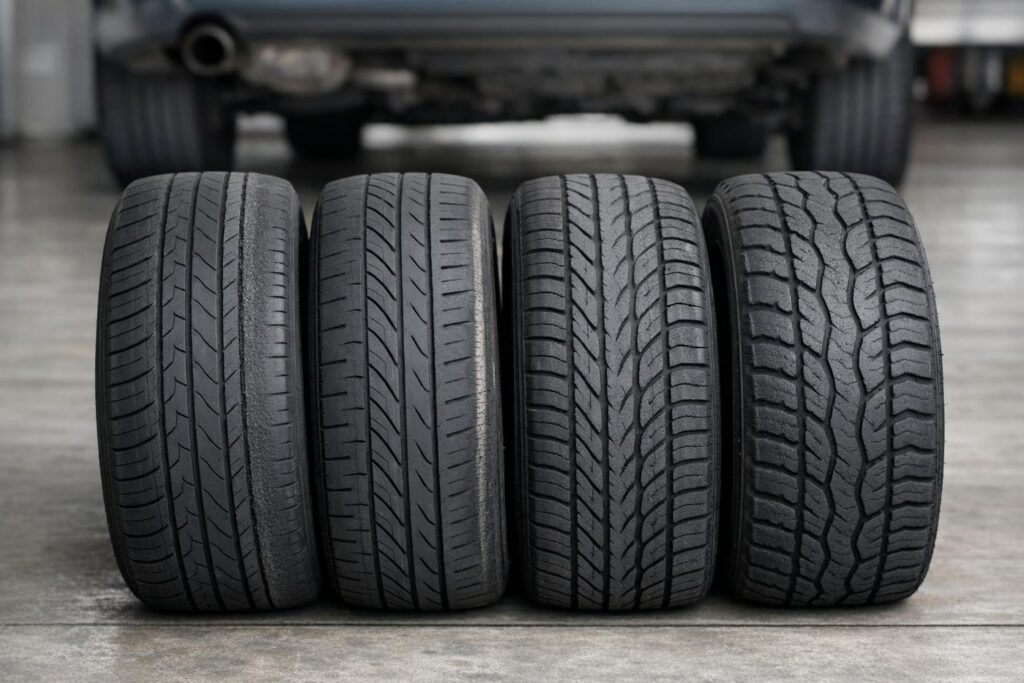
Quick decoding: the most common wear patterns (and what they usually mean)
Use the patterns below as a guide—not a final diagnosis. Multiple issues can stack (for example: worn shocks + toe misalignment), and front vs. rear wear can suggest different causes depending on drivetrain and suspension design.
| Wear pattern | What it looks/feels like | Common causes | What to do before buying |
|---|---|---|---|
| Inner-edge wear | Inside shoulder is noticeably more worn than the rest | Often alignment-related (negative camber and/or toe issues), sometimes worn suspension parts | Request an alignment check printout; inspect control arm bushings/ball joints; plan for tires |
| Outer-edge wear | Outside shoulder is worn faster | Alignment (camber), chronic underinflation, aggressive cornering | Verify door-jamb tire pressure spec; check for suspension looseness; ask about rotation history |
| Feathering (sawtooth) | Run your hand across tread blocks: one direction feels smooth, the other feels sharp/choppy | Toe misalignment is a frequent culprit; can be worsened by bent/worn steering/suspension parts | Expect alignment + steering/suspension inspection; test drive for pull/wander |
| Cupping / scalloping | “Dips” around the tread circumference; often noisy (humming/whirring) | Worn shocks/struts, balance issues, suspension looseness | Budget for shocks/struts inspection; check for tire noise at 35–55 mph; ask about balancing |
| Center wear | Middle of tread wears faster than both shoulders | Overinflation is common; sometimes wrong tire size/load rating | Check current PSI vs. door-jamb spec (cold); verify correct tire size |
| Both edges worn | Both shoulders wear faster than the center | Underinflation; heavy loads; infrequent pressure checks | Look for heat damage/cracking; ask about load use (towing/cargo); plan a full tire evaluation |
Pro tip for buyers: Don’t just look—feel. Feathering is often easier to detect by running your hand lightly across the tread than by eye alone.
Step-by-step: a 10-minute tire-and-alignment screening you can do at the lot
1) Check all four tires—front and rear can tell different stories
Walk the car and compare the tires side to side. Mismatched brands or tread depths can be a normal replacement choice—or a sign someone replaced only the “worst” tires to make the car look sell-ready.
2) Look for inside-edge wear (the spot sellers hope you won’t notice)
Turn the steering wheel fully left, then fully right, and peek at the inside shoulder of the front tires. If the inside edge is bald while the rest looks “fine,” that’s a classic alignment/suspension red flag—often toe/camber-related.
3) Feel for feathering (toe misalignment clue)
With the car parked, lightly run your hand across the tread blocks. If it feels smooth one way and sharp the other, toe may be out of specification. Toe issues can “scrub” tread quickly, so feathering is a strong reason to ask for an alignment evaluation before purchase.
4) Watch for cupping and listen during the test drive
Cupping often pairs with a droning or humming road noise that changes with speed. On the drive, note any vibration through the seat or steering wheel. That can be balance-related, but it can also point to worn suspension parts that need a closer inspection.
5) Check tire age and basics (pressure, cracking, repairs)
Look for sidewall cracking, uneven patches, and old plug repairs. Also check for treadwear indicators (wear bars) inside the grooves. If wear bars are close, you’re negotiating tire replacement immediately—no matter how good the car looks.
Safety reminder: Federal tire-safety guidance emphasizes correct inflation, rotations, and the role of alignment/balancing in maximizing tire life—plus the importance of treadwear indicators for recognizing end-of-life tread. If the tire story doesn’t add up, pause the deal and get an inspection.
How this connects to flood-region vehicles (and why Boise buyers should care)
Vehicles shipped in from flood-prone areas don’t always show obvious interior waterlines—especially after detailing. But water exposure can accelerate corrosion on suspension and steering components. That can translate into looseness, noise, and alignment that won’t “hold,” which eventually shows up as uneven tire wear.
What to ask the seller: “Do you have recent alignment specs?” and “Have any steering or suspension parts been replaced?” If the answer is vague and the tires show aggressive inner-edge wear or feathering, plan on a thorough pre-purchase inspection.
Local Boise angle: roads, heat, and driving corridors that influence wear
In the Treasure Valley, tire wear can speed up when summer pavement temperatures climb, and alignment can drift after repeated impacts from potholes, construction zones, and sharp curb taps. If your test drive includes I-84, Eagle Road, or surface streets with frequent lane shifts and patches, pay attention to steering feel—wandering, pulling, or a crooked steering wheel can correlate with the same wear patterns you’re seeing on the tires.
For local SEO and convenience, Naylor’s Auto Repair regularly helps drivers from Meridian, Eagle, Nampa, Caldwell, Kuna, Garden City, and Star who want a clear, technician-backed picture before buying a used vehicle.
When to stop guessing and schedule a pre-purchase inspection
If the tires show inner-edge wear, feathering, or cupping—and the seller can’t provide recent alignment documentation—an inspection can save you from buying into suspension repairs plus a tire set right away. A professional pre-purchase inspection also helps you negotiate with confidence using objective findings instead of hunches.
Prefer to start with alignment concerns? Explore our wheel alignment services and our approach to preventive maintenance.
FAQ: Tire wear patterns, wheel alignment, and used-car buying
Can a wheel alignment fix uneven tire wear that already happened?
Alignment fixes the cause, not the missing tread. If the tire is already feathered, cupped, or worn on one edge, it may stay noisy or ride rough even after alignment. Many situations require both: correct the alignment and replace the affected tires.
What tire wear pattern most strongly suggests alignment trouble?
Pronounced inner-edge or outer-edge wear is a common alignment clue, and feathering often points to toe being off. If you can feel a sawtooth edge across the tread blocks, plan on an alignment evaluation and a suspension/steering check.
Is cupping always an alignment problem?
Not always. Cupping frequently relates to worn shocks/struts, balance issues, or suspension looseness. Alignment can be part of the story, but a proper inspection should evaluate ride-control components and wheel balance too.
If the car pulls slightly, is that definitely alignment?
Pull can come from alignment, uneven tire pressures, mismatched tires, brake drag, or worn suspension parts. A quick check of cold tire pressures and a professional alignment measurement are the fastest ways to narrow it down.
What should I bring to a pre-purchase inspection in Boise?
Bring the vehicle listing, any maintenance records, and your top concerns (for example: “inner tire wear,” “steering wheel off-center,” or “road noise at 45 mph”). If you suspect flood-region history, mention where the vehicle lived previously so the inspection can include extra checks for corrosion and water-related issues.
Glossary: quick alignment and tire-wear terms
Toe: The direction the tires point relative to the vehicle centerline (slightly in or out). Incorrect toe commonly “scrubs” tread and can create feathering.
Camber: The inward or outward tilt of the wheel when viewed from the front. Excess camber can bias wear toward the inner or outer edge.
Caster: The forward/back tilt of the steering axis that affects stability and steering return. It’s not a “tread pattern” term, but it matters for straight-line tracking.
Feathering: A sawtooth feel across tread blocks (smooth one direction, sharp the other), commonly linked to toe being out of spec.
Treadwear indicators (wear bars): Raised bars molded into the grooves that become flush with the tread when the tire is worn down, signaling it’s time to replace.
If you’d like a technician to interpret tire wear patterns in person—and verify whether it’s alignment-only or a deeper suspension/steering issue—book an appointment with Naylor’s Auto Repair in Boise. Start here: Contact Naylor’s Auto Repair.